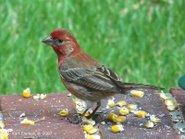
I got a few shots of a visitor to my backyard today as he was snacking on sunflower seeds. He was posing next to this great little feeder my wife Shelley got us which resembles the front of a church. He is a male House Sparrow, also known as the English Sparrow.
They were introduced to North America from Europe. They were released in New York City in 1850. Since that time, they have become widespread. In fact, they are the most abundant songbird in the world. 
The male House Sparrow has a distinctive black bib with a black bill. They have a gray cap with a black mask and a chestnut nape.
The females are not as distinctive and have a much different plumage than the male. They lack the black bib, black bill, and chestnut nape.
As the winter draws closer, the males lose the plumage as their black bib, black bill and chestnut nape lightens up. As you can see, this is gradually happening to this male visitor.
Sunday, October 14, 2007
Under The Church Steeple
Wednesday, October 10, 2007
First Blast of Fall!


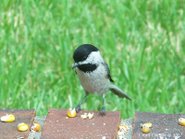
Then, it turned on the peanut feeder and faced down, in the typical Nuthatch posture. I've seen a White Breasted Nuthatch before, up on Brush Mountain, but it is a much bigger bird. This Nuthatch was much smaller than the White Breasted Nuthatch. The White Breasted Nuthatch is about 6" in length compared to only 4 1/2" for the Red Breasted Nuthatch. Also, notice that it has a dark eye line and a white eyebrow. The White Breasted Nuthatch has an all white face and breast.

The red breast is definitely noticeable and shows up. I believe this one to be a female Red Breasted Nuthatch. On the males, the rust colored underparts extend further up the neck.
Arkansas is in the winter range for the Red Breasted Nuthatch so this little blast of cooler weather appears to be causing a little movement. I'm excited!
Friday, October 5, 2007
Orange Sapsucker
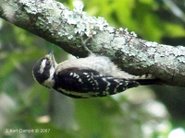
It's red belly, which it gets the name from, is rarely seen. It's back has a very noticeable upperparts with the black and white barring, like a zebra. So much so that is is sometimes called the Zebra Woodpecker.
The plumage of the sexes are very similar except the males have a complete red hood on their heads. The females, as noted in the pictures, only have red on the nape of their necks.They are fairly large woodpeckers, 9-10 inches in length, with a 15-18 inch wingspan. They are nonmigratory, monogamous birds. They have 1 brood in the North and 2 - 3 broods in the South.
Saturday, September 29, 2007
Colors of The Cardinal
Cardinals have had the run of my backyard lately. I've got several adults pairs and a bunch of juveniles feeding around the clock.Cardinals are non-migratory birds and are very abundant in the south and eastern half of North America. In the south, they are noted to have two sets of young as the weather turns warmer earlier.
They are noted for their bright red color. The adult males have a very distinctive orange bill with a black mask. Females are not red except on their wings and tail.I've noticed as the summer has turned to fall, the males color as faded ever so slightly. Notice the change in color from this picture that I got early on in the summer.
The juveniles are starting to acquire their color, in splotches. This is a juvenile male getting his 'red-ness'. The juveniles can be distinguished from the adults as they don't have the noticeable orange bill yet, being mostly black early on in age.Sunday, September 23, 2007
Fall has Fell, That Doesn't Sound Right!

I tried to come up with a snappy title about fall. The 'Spring has Sprung' phrase for spring starting sounds a lot better. Well anyway, fall is finally here.
The weather around here in Arkansas needs to catch up soon as we are having hotter than normal weather with the highs in the upper 80s. We should get some rain this week to cool things off.
My little Downy friend ventured into the birdbath for a little sip of water yesterday.
I got several pics of him in the bath. I included this picture because his red spot is noticeable on the back of his head.
I didn't realize until it was too late that he had his little wifey with him. He flew up to the tree after getting a drink. I watched him in the tree and then realized that she was in the tree also. She lacked the red spot that helps to distinguish between the two sexes.
Saturday, September 22, 2007
Save The Squirrels!
I just had to post a picture of a few of the squirrels in my backyard since today is the opening day of squirrel season in Arkansas. One of my buddies went hunting today and got his limit early.
Maybe someone will check out my blog and see just how cute these little guys are and think twice getting two many of these guys.
They are hungry little jokers though and can do some damage to my bird feeders if I don't keep them full!
Friday, September 21, 2007
He's Back!
It is very interesting to see the juvenile grow up over the last few months to essentially being grown so quickly. They just grow up so fast!
Friday, September 14, 2007
Always Be Prepared!
One thing I've learned in my short time of birding is 'Always be prepared'. You just never know when you are going to see a 'life bird' when you just don't expect it.
Now obviously, four Mallards waddling around in my yard don't fall under that category but I think everyone understands my meaning.
I've had several of those instances when I did have my camera with me and caught a few pics of new birds for me.
I got these pics of the Mallards the other day during afternoon when the remnants of Hurricane Humberto was blowing through. These Mallards are residents of my neighborhood, they are pets of one of the neighbors. They usually are flying around but were walking around feeding during the rain.
They appear to be two adult females and one adult male. The last one in the first pic above looks like a juvenile male just before his head turns the distinctive green color to me.
Wednesday, September 12, 2007
Still Alive! Juvenile Red-Headed Woodpecker & Me!
I know it has been a while since my last post. The birding has been very slow around here lately. I guess the birds are moving. Food sources are more abundant now probably also.
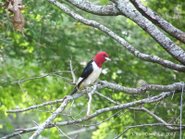
I was looking through my pictures from several weeks back and I ran across these pictures of my favorite bird this year. He finally learned how to land in the tray feeder and get a few seeds.
I've not have the opportunity to get any pictures of the juvenile Red-Headed Woodpecker lately. I was worried that he was gone for good know that he is grown.
But, good news! He is still around and flying high up in the tree tops with the other adults!
Also, I topped 500 hits last week! Woo hoo! I appreciate everyone checking in on my little birding blog. Thanks!
Saturday, September 1, 2007
Save the Doves!

I caught this picture of two mating Mourning Doves a few weeks ago. There are always a few doves foraging about in the backyard under the feeders to pick up the loose seeds that the other birds drop.